Big-budget magic on an indie budget. Sounds impossible, right?
We used to think so too. Then we discovered what happens when you combine procedural workflows, smart asset management, and the right tools. Suddenly, films made for around €60,000 started looking like they cost ten times more.
At Just Pictures Film, we specialize in indie film production that punches above its weight. Today, we're pulling back the curtain on our post-production process. No hype. Just the practical techniques we use every day to transform raw footage into something extraordinary.
Here's what most indie filmmakers face: limited time, limited money, and unlimited ambition. The gap between vision and resources can feel crushing.
But constraints breed creativity. And the tools available today: Houdini, Unreal Engine, Nuke, DaVinci Resolve: have leveled the playing field in ways that would have seemed impossible a decade ago.
The secret isn't working harder. It's working smarter. Building systems that let you do more with less. Creating once, using many times.
Let us show you exactly how we do it.
Houdini changed how we approach visual effects. Instead of building each effect from scratch, we create procedural setups: systems that can adapt, evolve, and respond to changes without starting over.
Think of it like this: traditional VFX work is like sculpting a statue. You carve it once, and if the client wants changes, you're back to chipping away at stone. Procedural workflows are more like building with intelligent LEGO blocks. Swap one piece, and everything adjusts automatically.
Here's what this means in practice:
When we need mist rolling through a forest scene, we don't create it shot by shot. We build a mist system. That system understands density, movement, and light interaction. When we move to the next scene, we adjust a few parameters, and the mist adapts.
Same principle applies to water effects, particle systems, and environmental atmospherics. Build smart. Reuse endlessly.
For films working with budgets around €60,000, this approach isn't optional: it's essential. Every hour saved in post-production is an hour you can invest in story, performance, or that one impossible shot you've been dreaming about.
We've learned that the most convincing visual effects rarely come from a single spectacular render. They come from layers: dozens of them: combined with precision and care.
Our typical workflow separates everything:
Why separate everything? Because separation means control. When the director wants more fog in frame left, we adjust one layer. When the colorist needs cleaner plates for grading, they're already isolated. When we discover that a bird element works better in a different shot, we simply move it.
This flexibility becomes your safety net. And on indie productions where reshoots are rarely possible, that safety net is everything.
Unreal Engine has fundamentally changed what's possible for independent filmmakers. We use it for environment creation, virtual production elements, and increasingly, final pixel delivery.
The real-time nature of Unreal means we can iterate at the speed of thought. Instead of waiting hours for renders, we see results immediately. Directors can make creative decisions on the spot. Problems get solved before they become expensive.
For our recent projects, we've built entire environments in Unreal: cliffs, oceans, alien landscapes: that would have required massive location budgets or months of traditional CG work. The base renders come out of Unreal, then we enhance them with Houdini elements and composite everything together.
One ocean scene we created started with Unreal's water system, added Houdini-generated white water and spray details, layered in CG birds and atmospheric haze, then received final compositing in Nuke. Each element rendered separately. Each element adjustable. The final result? A shot that feels epic without the epic price tag.
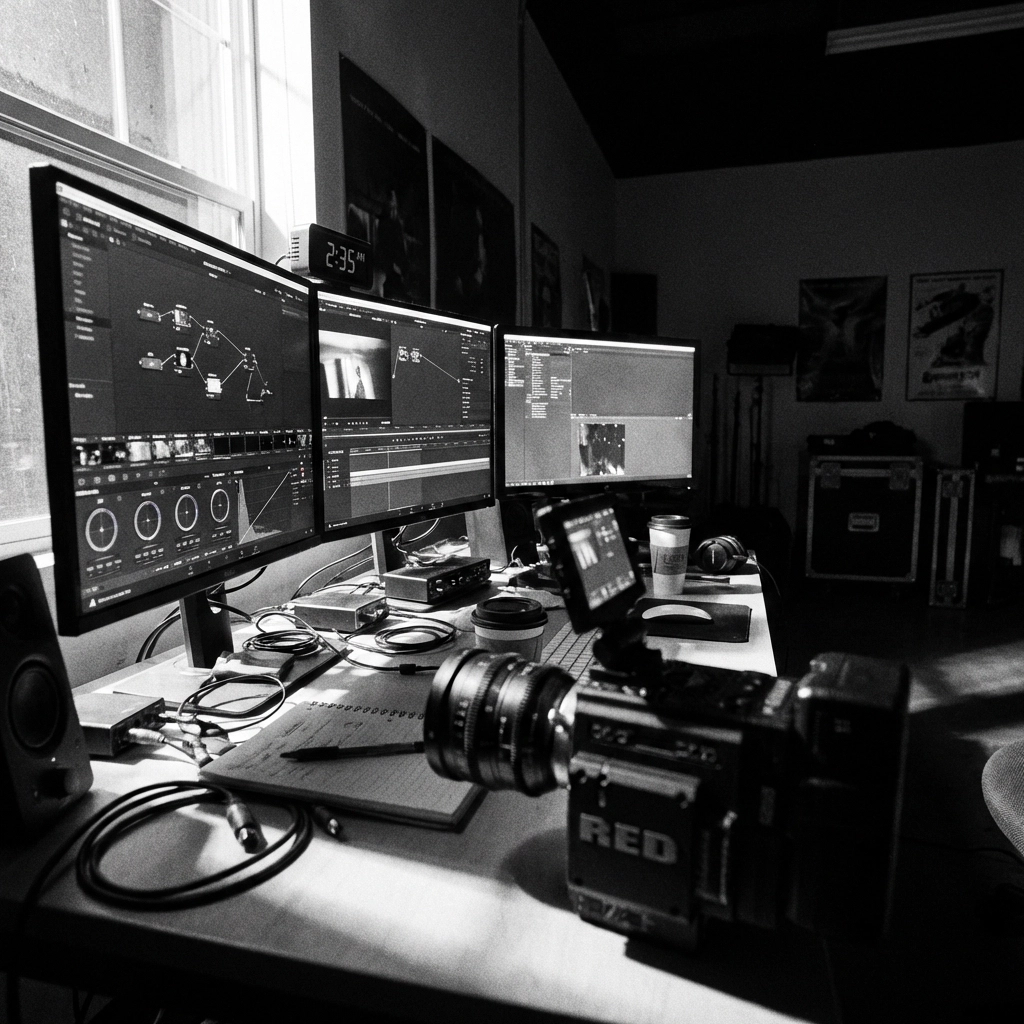
Great post-production starts with great footage. We shoot on RED cameras because the flexibility in post is unmatched at this budget level.
That raw sensor data gives our colorists in DaVinci Resolve enormous latitude. Pushed exposure? Recovered. Color temperature wrong? Fixed. The dynamic range means we capture details in shadows and highlights that cheaper cameras simply miss.
When footage arrives in post looking clean and flexible, everything downstream becomes easier. Effects integrate better. Color grades have room to breathe. The final image has that professional depth that separates serious indie work from amateur efforts.
Let us walk you through how a typical shot moves through our pipeline:
1. Ingest and Organization
RED footage comes in, gets backed up twice, then organized by scene and take. DaVinci Resolve handles transcoding and initial organization.
2. Editorial
The editor works with proxy files while full-resolution media waits for finishing. Creative decisions happen fast without storage headaches.
3. VFX Handoff
Shots requiring effects get exported with clean plates, roto mattes, and tracking data. Everything the VFX team needs arrives organized and labeled.
4. Effects Creation
Houdini generates procedural elements. Unreal Engine provides environments. Each pass renders separately for maximum flexibility.
5. Compositing
Nuke brings everything together. Layer by layer, the shot builds toward completion. Multiple iterations happen quickly because nothing is baked together prematurely.
6. Color and Finishing
Final composite returns to DaVinci Resolve for color grading and delivery. The colorist has clean, properly prepared footage to work with.
This pipeline isn't glamorous. But it works. And it scales: whether we're finishing a short film or a feature.
After years of collaborative filmmaking, we've learned what derails indie post-production:
Rendering too early. Committing to final renders before creative decisions are locked wastes time and money. Keep things flexible as long as possible.
Ignoring organization. When you can't find assets, you recreate them. When you recreate them, you burn budget. Stay organized from day one.
Skipping tests. That complicated effect needs testing before the deadline crunch. Build proof-of-concept versions early. Discover problems while there's still time to solve them.
Working in isolation. Post-production works best when the whole team communicates. Directors should see work-in-progress. Editors should understand VFX limitations. Colorists should know what's coming.
If you're evaluating independent film projects, understanding post-production capabilities matters. A team that knows these tools: that has built efficient pipelines: can deliver more production value per euro than teams working with outdated methods.
We're always interested in connecting with collaborators who share our vision for what indie film can achieve.
Every technique we've shared comes from the same place: a refusal to accept that limited budgets mean limited quality. We believe independent filmmakers deserve access to the same visual power that studios take for granted.
The tools exist. The knowledge is learnable. What matters is the commitment to push boundaries, to embrace the learning curve, and to keep refining the craft.
We're building a team of artists who share this passion. People who see constraints as creative fuel. Who want to prove that compelling visuals don't require unlimited resources: just unlimited dedication.
